
We hope you join us for the next and final program. What STILL Makes Missouri So German? (Oct. 10) 7pm at the Missouri History Museum.
This panel will explore the ways in which German culture lives on in our community today at local and national levels. Moderator Dorris Keeven-Franke will introduce Consul General Herbert Quelle who will share Deutschland Jahr, Steve Belko from the Missouri Humanities Council who will talk about the German Heritage Corridor, the St Louis-Stuttgart Sister Cities President Susanne Evens who will talk about the Sister Cities Programs, and the German language initiatives, and all will speak on other issues related to contemporary German American life. This program is free and takes place at the Missouri History Museum. Please share this invite.
German History, Culture, Community
There are still seats available at the Feast, but please hurry with your reservations as seats are limited. Call 314-361-9017 or you can go online at http://mohistory.org/events/german-american-day-fest-and-feast_1538838000
What Makes Missouri So German? (Oct. 3)
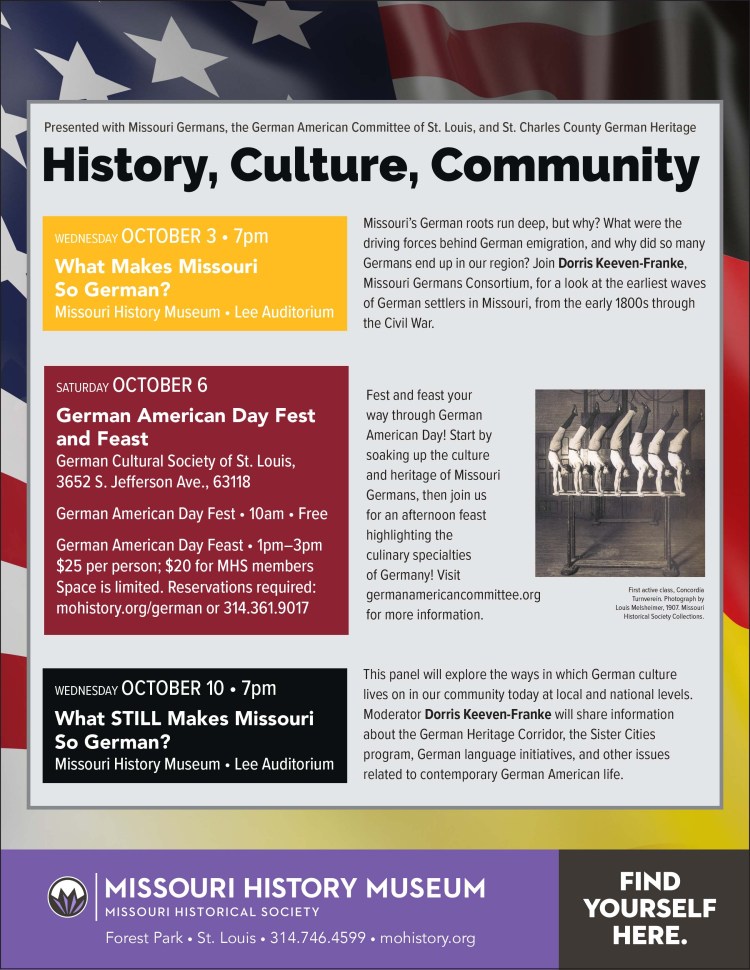
Missouri’s German roots run deep, but why? What were the driving forces behind German emigration, and why did so many Germans end up in our region? Join Dorris Keeven-Franke, Missouri Germans Consortium, for a look at the earliest waves of German settlers in Missouri, from the early 1800s through the Civil War.
This program is free and takes place at the Missouri History Museum.
German American Day Fest and Feast (Oct. 6)
Fest and feast your way through German American Day! Start by soaking up the culture and heritage of Missouri Germans, then enjoy an afternoon feast highlighting the culinary specialties of Germany! Visit germanamericancommittee.org for more information.
This event takes place at the German Cultural Society of St. Louis at 3652 S. Jefferson Ave., 63118.
The Fest is free! Tthe Feast is $25 per person (or $20 for MHS members) and registration is required at mohistory.org/german.
What STILL Makes Missouri So German? (Oct. 10)
This panel will explore the ways in which German culture lives on in our community today at local and national levels. Moderator Dorris Keeven-Franke will share information about the German Heritage Corridor, the Sister Cities program, German language initiatives, and other issues related to contemporary German American life.
This program is free and takes place at the Missouri History Museum. Panel is Consul General Herbert Quelle, Dr. Steven Belko and Susanne Evens.
This series is presented with Missouri Historical Society, Missouri-Germans, the German American Committee STL, and St. Charles County German Heritage Club
Die Tanzgeiger
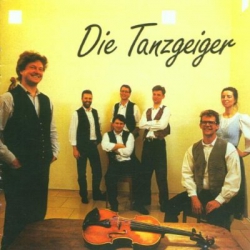
Die Tanzgeiger (The Dance Fiddlers) is performing in New Town (St Charles) on Sunday Sept 30th, 6p-8pm! Die Tanzgeiger is the name of a seven-member ensemble hailing from the eastern provinces of Austria. This group uses a delightful combination of fiddles and other instruments to produce traditional folk music from Austria. These versatile tunes inspire dancing but are also valued in a concert setting. When listening to the music of the Tanzgeiger, one is transported into an atmosphere of powerful, heartfelt, and genuine music, with just the right dose of jaunty sass. People unfamiliar with authentic Austrian folk style are always surprised by its subtlety, complexity, and unusual sonorities.
Over the four decades of the group’s history, even as instrumentation, repertoire, and arrangements have changed, the intimate tie with their own roots and ear for the new and the foreign have remained constant. The group depicts both rural and urban Austrian musical styles. They have taken melodies from friends all over Europe: on tours from Norway to the Czech Republic and Hungary, from the Ukraine to Spain, they have collected memories that add the sparkle of many ethnic groups to their programs. As a result, the group has an approachable, welcoming musical language. As the Münchner Merkur wrote of the group, “With both a healthy splash of gypsy blood and of Nordic melancholy, the musicians convey common roots and multiple cultures at the same time.”
The ensemble performs exciting traditional music for a wide variety of occasions, and they can adjust their programs to suit the needs of particular events. Their repertoire consists of instrumental and vocal music, including folk songs and authentic Alpine yodelling, presenting a musical cross-section that links country and city, folk music and high art. Particular genres include waltzes, Ländler, polkas, marches, Jodler, Wienerlieder, Gstanzl, and Schrammelmusik. The roots of this music lie in the “long nineteenth century” (1750-1950), and thus it has close ties to Gustav Mahler, Viennese classicism, and especially Franz Schubert.
All the group’s musicians have academic training, and some are teachers and professors. They enjoy supplementing their concerts with workshops for children or students. The mix of young players with veterans who have decades of experience has only strengthened this group’s ability to provide traditional, entertaining, and spontaneous Austrian folk music to audiences young and old.
The Tanzgeiger appeared in 2002 at The Bard Music Festival “Mahler and His World” in a spectacular performance designed to show the roots of Mahler’s music in Austrian folk traditions. They look forward to visiting the US once more this fall to play for concerts and dances and join Oktoberfest celebrations. They can also present lecture-recitals and musical workshops. Sponsors for concerts arranged thus far include the University of Wisconsin-Madison, the Missouri Humanities Council, and Grand Valley State University (Michigan). To inquire about possible events, contact Lisa Feurzeig (feurzeil@gvsu.edu) or Rudi Pietsch (pietsch@mdw.ac.at).
Members of The Tanzgeiger
Rudi Pietsch (violin, vocal): Vienna & Niederösterreich. Professor emeritus, Institute for Folk Music Research at the Vienna University of Music and Performing Arts. Fulbright Scholar to US, 2010. Doctoral dissertation: The Music of Burgenlandian Emigrants and their Descendants in the US: the Instrumental Music of the Burgenland-Americans in the Lehigh Valley, Pennsylvania. He also plays the Schwegel, a small wooden flute-like instrument. Currently he teaches in Salzburg at the Mozarteum and gives masterclasses all over Europe.
Theresa Aigner (violin, vocal): Vienna & Oberösterreich. Currently studying for a master’s degree in violin pedagogy at the Vienna University of Music and Performing Arts. Along with her activities in folk music, she also plays in classical orchestras such as the Vienna Mozart Orchestra and in a traditional Viennese Schrammelquartett, Wiener Pretiosen.
Marie-Theres Stickler (button box accordion, vocal): Vienna & Niederösterreich. Studied folk music at the Mozarteum in Salzburg. Now a freelance musician and a member of many bands, including Alma and Martin Spengler und die foischn Wiener. She also plays the Schrammelharmonika (a distinctive kind of accordion) for concerts of traditional Viennese music in Heurigen (Viennese wine bars).
Michael Gmasz (viola, vocal): Vienna & Burgenland. Studied viola at the Vienna University of Music and Performing Arts and musicology at the University of Vienna. Now he is a radio announcer at Radio Klassik Stephansdom and also a member of Ensemble Klezmer Wien.
Sebastian Rastl (double bass, vocal): Vienna & Steiermark. Studied double bass in Eisenstadt and Graz. Now he is freelance and a member of classical and folk music ensembles. He also plays the tuba.
Claus Huber (trumpet, vocal): Vienna & Burgenland. Studied trumpet at the Vienna University of Music and Performing Arts and civil engineering at the Vienna Technical University. He also wrote a science dissertation at the Institute for Viennese Sound Style. Now he runs a big construction company and is also leader of the brass band Die Schürzenträger.
Dieter Schichbichler (trombone, vocal): Vienna & Steiermark. Studied trombone at the Vienna University of Music and Performing Arts. He now teaches in a music school and plays in the brass band Ma chlast.
Hidden History
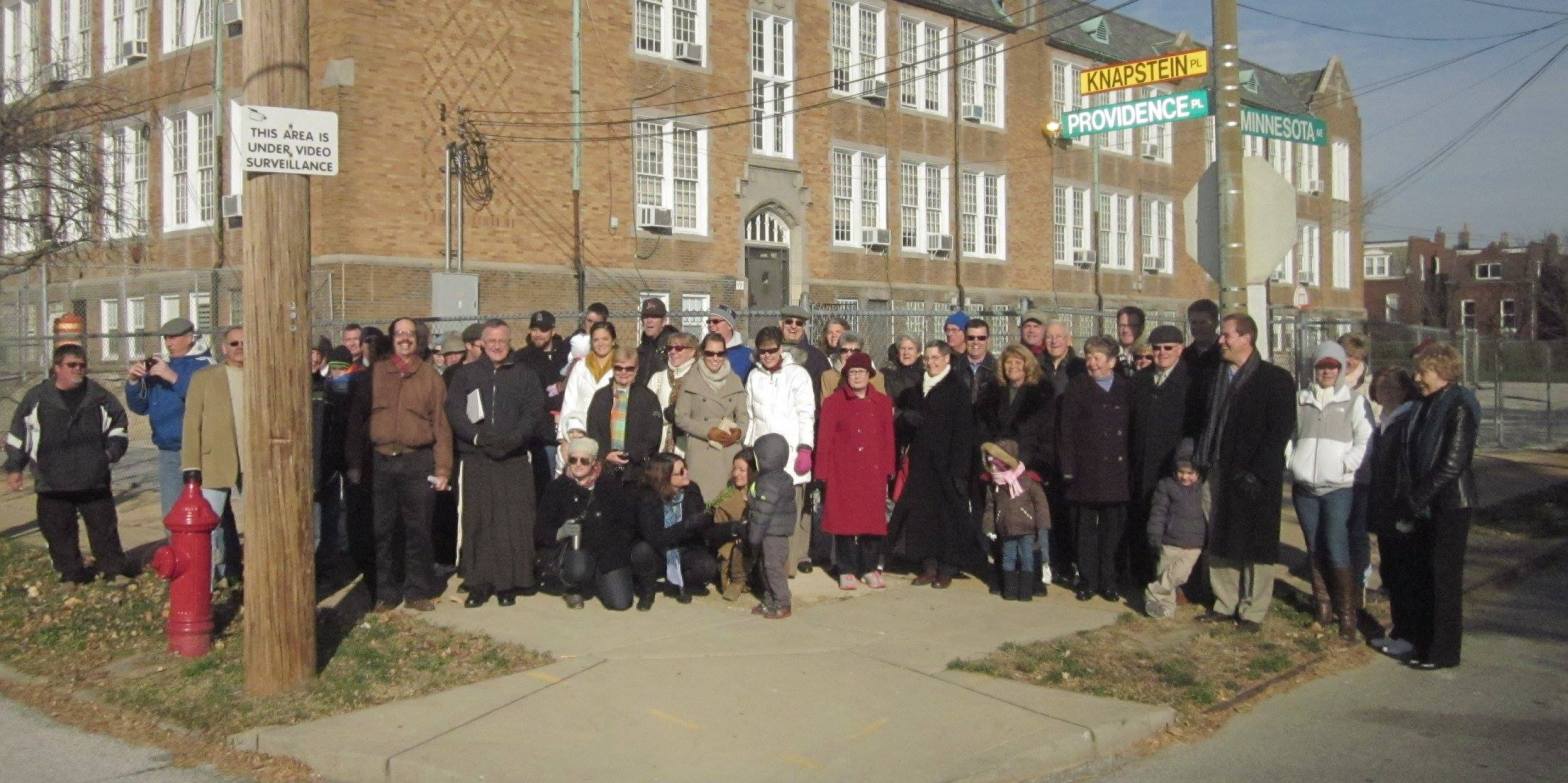
Oct. 27 Memorial events to celebrate hidden piece of St. Louis history
By Jim Merkel
Anti-German hysteria during World War I shut the door on German culture in the Gateway City. During World War I, patriotic German Americans were made to choose between their heritage and their nation. Schools ended their German language education programs. Churches were pressured to stop holding services in German. In Collinsville,  Illinois, a mob went farther by lynching a German alien named Robert Prager.
Illinois, a mob went farther by lynching a German alien named Robert Prager.Now the German American Heritage Society of Saint Louis (GAHS) and author Jim Merkel have developed a citywide memorial to this time of anti-German hysteria in street corners around the city.
They’ll celebrate these memorials on Oct. 27, fifteen days before the 100th anniversary of the end of World War I. “These honorary designations are an important historical artifact for St. Louis. When someone walks by these signs, they will learn the stories behind the old names and the new names, and the important lesson underneath,” said James Martin, president of GAHS. “On this 100th anniversary of the end of World War I, these signs provide a concrete reminder of our past, and will hopefully provide insight and wisdom for future generations.”
For five years, GAHS and Merkel have worked to mark the six streets whose German “enemy” names were changed during World War I. So far, they have completed the time consuming process of obtaining city approval for honorary designations noting the original German names for four streets. The city also has granted the honorary designation of “Robert Prager Way” on Bates Street between Morgan Ford Road and Gravois Avenue in the Bevo Mill neighborhood. It’s next to St. Matthew Cemetery, where Prager is buried.
On Oct. 27, honorary street signs in German colors for Robert Prager Way will be dedicated at 9 a.m. at the corner of Bates and Morgan Ford. The Bismarck Street signs will be dedicated at 10:30 a.m. at Seventh and Lami street. Depending on city and neighborhood approvals, there will be additional ceremonies on Oct. 27 or later.
The Oct. 27 ceremonies will conclude with a reception and program open to the public at a place to be designated. Details will be posted at https://germanamericancommittee.org/ as they are finalized.
Anti-German hysteria during World War I shut the door on German culture in the Gateway City
The three honorary streets that have already been dedicated are: Knapstein Place (now Providence Place.) in the Dutchtown neighborhood; Kaiser Street (now Gresham Street) in the Princeton Heights neighborhood; and Habsburger Avenue (now Cecil Place) in the Boulevard Heights neighborhood. Two streets that are under review for designations or markers are Von Versen Avenue (now Enright Avenue) in the West End neighborhood and Berlin Avenue (now Pershing Avenue) in the Skinker-DeBaliviere neighborhood.
Merkel began the campaign to give the streets the honorary designations after learning of the anti-German hysteria while he was writing his book, Beer, Brats, and Baseball: St. Louis Germans. In 2013, he teamed up with GAHS to promote the concept. Under city ordinance, a street or a portion of a street may receive an honorary name designation if
at least 60 percent of registered voters in that area sign a petition requesting it. Then the alderman for that area may introduce a bill calling for the designation. Alderman often request support from neighborhood organizations first. The actual street name stays the same.
The city requires an organization to pay for honorary street signs. GAHS is paying the cost for signs in bright German colors. Organizers see the citywide series of honorary street signs as more than a memorial to what happened to German Americans in World War I. They view it as a reminder that any person, group or nationality can be targeted under certain circumstances.
For more information contact: Jim Merkel 314-799-5117, or southsidemerkel@gmail.com
or visit GAHS on Facebook https://www.facebook.com/groups/gahs.stlouis/
History, Culture and Community
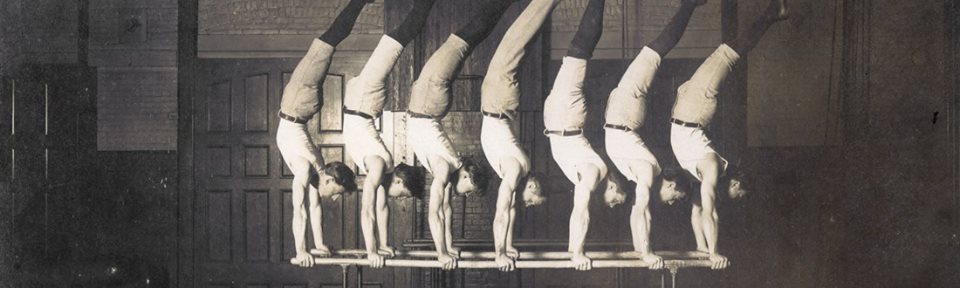
Every fall as the leaves turn, and the weather softens, we begin to hear the sounds of a German band playing in the distance. The announcements of Oktoberfests spring from every corner, and the beer kegs are stacked in readiness. What if there was another way to celebrate your German-American heritage, and get in touch with the culture and the community?
Join us for this family friendly week of programs that celebrate the St. Louis region’s wonderful German-American heritage with several programs, events, and even a feast as we celebrate German American Day in the St. Louis region! Don’t worry… there will be some German beer, brats and music as no German celebration is complete without them!
German-Americans: History, Culture and Community
Germans have been part of America’s history since 1683, when a group of immigrants, thirteen families, from Krelfeld landed at Philadelphia, and founded Germantown, Pennsylvania. In 1688, they filed the first petition ever written, to abolish slavery, in the colonies. In 1883, German Americans in Philadelphia, began to celebrate this heritage with Deutsch-Amerikanischer Tag or German American Day. This spread throughout the United States, and every German-American community would also use this day to honor this heritage. This tradition has even survived the anti-German sentiment of World War I and II. And, in 1983, President Ronald Reagan proclaimed October 6, 1983 officially German-American Day.
In St. Louis, Missouri, one of the largest strongholds of German-American heritage, the German-American Committee of St. Louis, was officially founded in 1983. We work to preserve, educate and promote the German-American heritage of St. Louis. Please join us at the following events.
- Oct 3 – Germans in St. Louis: History, Culture, Community – What Makes Missouri So German? Missouri’s German roots run deep, but why? What were the driving forces behind German emigration, and why did so many Germans end up in our region? Join Dorris Keeven-Franke, Missouri Germans Consortium, for a look at the earliest waves of German settlers in Missouri, from the early 1800s through the Civil War. This program is free and takes place at the Missouri History Museum, at 7pm in the Lee Auditorium.
 Oct 6 GERMAN AMERICAN DAY FEST & FEAST Start by soaking up the culture and heritage of Missouri’s German American community, then enjoy an afternoon feast highlighting the culinary specialties of Germany!
This event opens at the German Cultural Society of St. Louis at 3652 S. Jefferson Ave., 63118 when the Hall opens at 10 am. Visit the hall and meet representatives of all 18 active German-American organizations in the St. Louis region. The Fest is free and is open until 4pm! The Feast begins at 1pm and is a delicious German meal and is $25 per person (or $20 for MHS members) and registration is required at mohistory.org/german. There will be lots of German entertainment and celebration throughout the day!- Oct 10 What STILL Makes Missouri so German – Missouri Germans Consortium – This Panel will include Consul General Herbert Quelle, Dr. Steve Belko, and others. It explores the German-American culture and community of today – the topics will include the German Heritage Corridor, Sister Cities and German Language Initiatives, and more. This event is free and takes place takes place at the Missouri History
This day is presented as part of the series
Germans in St. Louis: History, Culture, Community series
by The German American Committee of St. Louis, the Missouri Historical Society, and the Missouri Germans Consortium. Please visit one of our websites for more information:
GermanAmerican Committee of St. Louis
Tanzgruppe and Musikanten

AUGUST 26, 2018
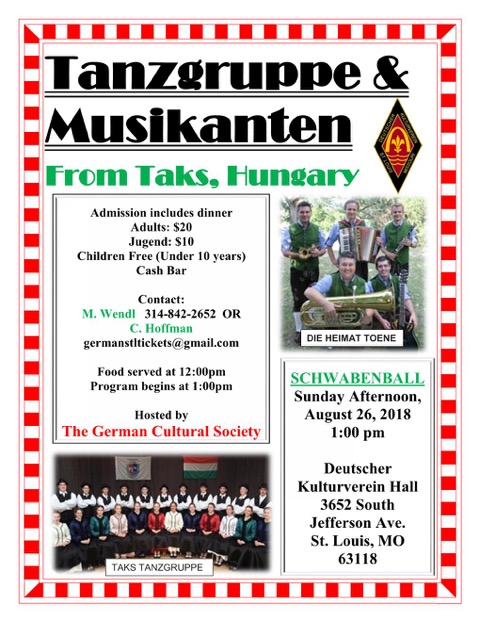
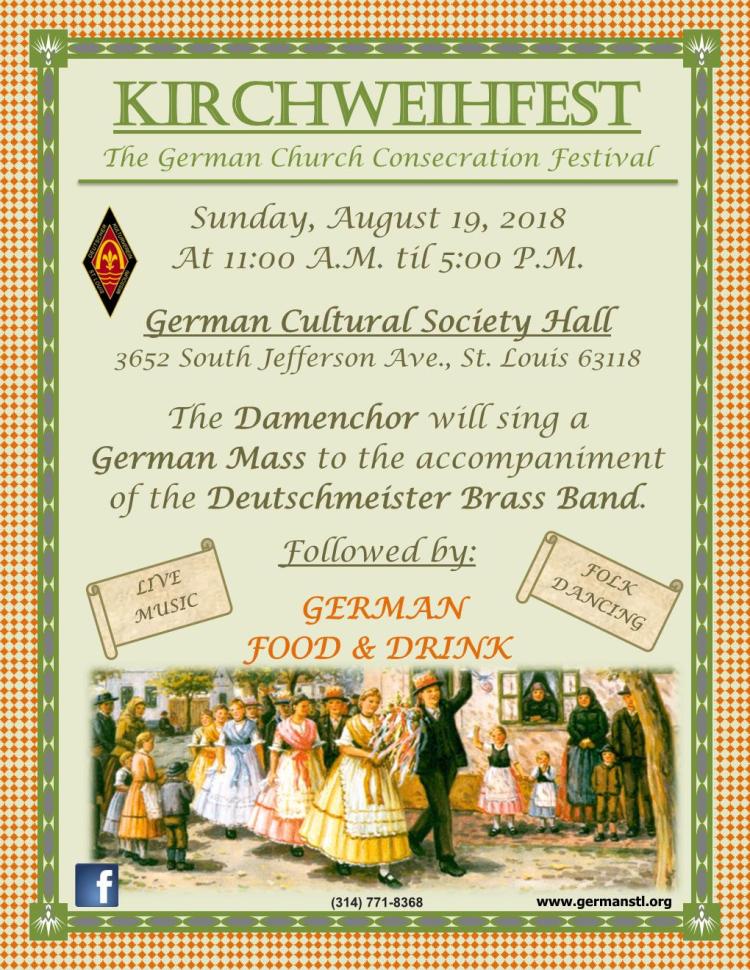
Kirchweifest – August 19

German American Day
The German American Committee of St. Louis and the Missouri History Museum present
GERMAN AMERICAN DAY
Fest and Feast
OCTOBER 6, 2018
3652 S. Jefferson Avenue, St. Louis, MO 63118
10 am – 4 pm Join us for a FEST of German organizations! Meet and Greet the 18 German Organizations of the St. Louis Region and learn more about how you can become more involved and connect with your heritage! The hall is open from 10am to 4 pm and everyone is invited. Enjoy a day with all of the German organizations in St. Louis.
1 pm – 3pm Feast your way through Germany with a culinary tour! Enjoy an afternoon feast highlighting the culinary specialties of Germany! The Feast takes place in the Grand Hall and reservations must be made in advance as space is limited. For the dinner reservations $25 in advance go to http://mohistory.org/events/german-american-day-fest-and-feast_1538848800 and click on the register link at the bottom or call 314-746-4599 and ask for reservations. Enjoy the music, dancing and food of the Germany.
3-5 pm Following the Feast will begin FREE performances at 3pm by St. Louis’ own Mannerchor (Men’s Choir), Dammenchor (Women’s Choir) and our own Liederkranz, the oldest combined men and women’s German singing group west of the Mississippi.
JOIN US FOR A DAY LONG CELEBRATION OF THE ST. LOUIS GERMAN-AMERICAN COMMUNITY AND NATIONAL GERMAN-AMERICAN DAY
This day is presented as part of
Germans in St. Louis: History, Culture, Community
- Oct 3 – Germans in St. Louis: History, Culture, Community – What Makes Missouri So German? Missouri’s German roots run deep, but why? What were the driving forces behind German emigration, and why did so many Germans end up in our region? Join Dorris Keeven-Franke, Missouri Germans Consortium, for a look at the earliest waves of German settlers in Missouri, from the early 1800s through the Civil War. This program is free and takes place at the Missouri History Museum, at 7pm in the Lee Auditorium.
- Oct 6 GERMAN AMERICAN DAY = FEST & FEAST Start by soaking up the culture and heritage of Missouri’s German American community, then enjoy an afternoon feast highlighting the culinary specialties of Germany!
This event opens at the German Cultural Society of St. Louis at 3652 S. Jefferson Ave., 63118 when the Hall opens at 10 am. Visit the hall and meet representatives of all 18 active German-American organizations in the St. Louis region. The Fest is free and is open until 4pm! The Feast begins at 1pm and is a delicious German meal and is $25 per person (or $20 for MHS members) and registration is required at mohistory.org/german. There will be lots of German entertainment and celebration throughout the day! - Oct 10 What STILL Makes Missouri so German – Missouri Germans Consortium – This Panel will include Consul General Herbert Quelle, Dr. Steve Belko, and others. It explores the German-American culture and community of today – the topics will include the German Heritage Corridor, Sister Cities and German Language Initiatives, and more. This event is free and takes place takes place at the Missouri History Museum
by The German American Committee of St. Louis, the Missouri Historical Society, and the Missouri Germans Consortium. For more information call 636-221-1524 or please visit one of our websites for more information
GermanAmerican Committee of St. Louis
Friedrich Hecker Event

Friedrich Hecker was a hero to the vast majority of German Americans living in the United States during the mid-19th Century. The Friedrich Hecker Monument was 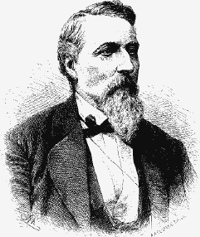 dedicated on October 1, 1882 before a crowd of over 15,000 in our beautiful Benton Park, in St. Louis, Missouri.Born September 28, 1811 in Eichtersheim, Grand Duchy of Baden, he was a German lawyer and politician, and one of the primary agitators in the 1848 Revolutions in Germany. Following the 1848 German Revolution he moved to the United States, but maintained an acute interest in events in Germany. In the spring of 1849, the Baden revolution re-ignited, and Hecker returned to Europe to participate. However, he only made it as far as Strassburg when word came that the insurrection had been defeated by Prussian troops and he returned to Illinois once again.
Leading up to the Civil War, he became increasingly focused on the issue of abolishing slavery, and wrote the forward to a German translation to Thomas Paine’s The Rights of Man so that all of his fellow Germans could know this great writing. After the Battle of Fort Sumpter, when Lincoln called for 75,000 volunteers, Hecker would begin recruiting,  and Illinois exceeded its allotment of 6,000 volunteers in five days. Hecker would serve as a Brigade commander in the Union Army during the Civil War, leading the 3rd Brigade, 3rd Division, XI Corps. After the war, Hecker returned to his farm in Summerfield, Illinois. It was in 1871 that he gave his very famous address at St. Louis of his enthusiasm for the German Americans and their glorious future in their newly united Fatherland, the United States. He passed away on March 24, 1881 and was buried at his farm in Lebanon, Illinois called Summerfield.
On Sunday, August 12, 2018 Johannes Fechner (MdB) a member of the German Bundestag, visited our area to lay wreaths at both the Benton Park Memorial and the burial site in Summerfield, Illinois. Members of the Illinois Civil war Hecker Regiment were at the Summerfield Ceremony along with members of the Missouri Sons of Union Veterans. The wreath laying at Benton Park took place at 10am. located at 2101 Wyoming St. St. Louis, 63118. The wreath laying at Summerfield took place at 12pm Noon and was at 9920 Summerfield South Rd, Lebanon, Illinois.
The beautiful afternoon was celebrated of course at the Hofbrauhaus St. Louis!


Quelle receives Freedom Award
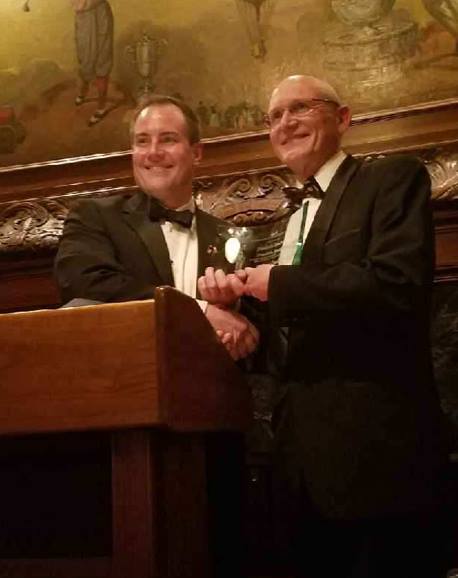
GAHS honors German Consul General, Herbert Quelle, with the 2018 Friedrich Hecker Freedom Award.
GAHS President, James Martin, presented the award at the organization’s 28th Annual black-tie Diplomatic Reception & Dinner on 10 March 2018 celebrating the founding of the German American Heritage Society of Saint Louis in 1990 at the Racquet Club-St. Louis. The crystal award is presented, “in recognition of those who have helped in the promugation of cooperation and understanding between Germany and the United States” (photos courtesy of J.Martin, J.Hecker and M. Rambo).
 GAC-STL